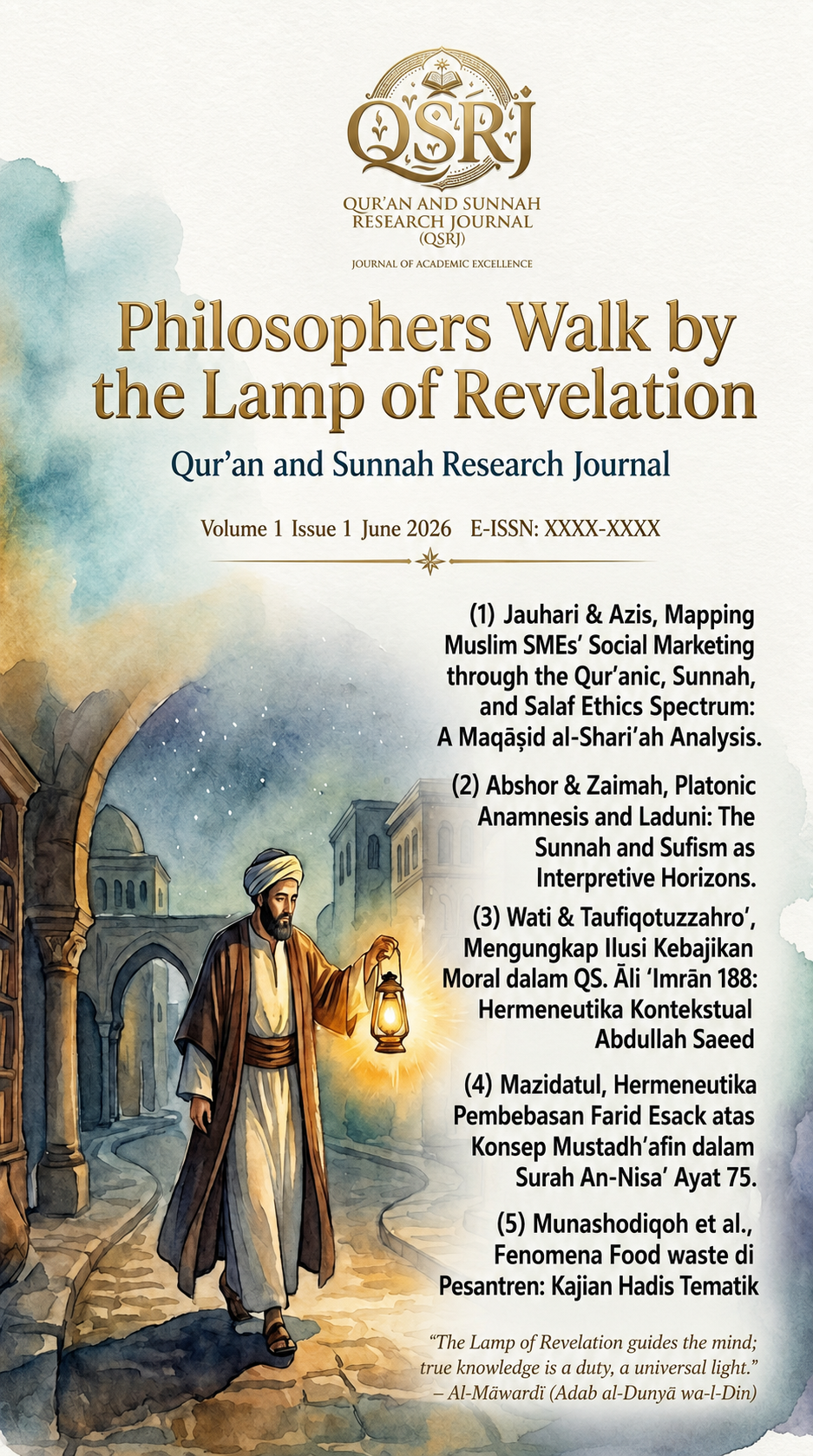
Mapping Muslim SMEs’ Social Media Marketing through the Qur’anic, Sunnah, and Salaf Ethics Spectrum
A Maqāṣid al-Sharī‘ah Analysis
Keywords:
Prophetic Business Ethics , Social Media Marketing , Muslim SMEs , Maqāṣid al-Sharī‘ah , Halal-Washing , Islamic Digital EthicsAbstract
The rapid expansion of social media has transformed marketing practices among Muslim small and medium-sized enterprises (SMEs), creating new opportunities for market growth while simultaneously raising ethical concerns. The increasing use of halal labels, religious symbols, influencer endorsements, and persuasive digital content has generated challenges related to halal-washing, misleading promotional claims, fabricated testimonials, and symbolic religious branding. This study aims to examine how akhlāq al-tijārah al-nabawiyyah (Prophetic business ethics) can serve as a normative and analytical framework for evaluating Muslim SMEs’ social media marketing practices. Employing a qualitative library research design, the study analyses Qur’anic verses, Prophetic traditions, classical Islamic scholarship, and contemporary literature on Islamic business ethics, digital marketing, and Maqāṣid al-Sharī‘ah. Data were analysed through thematic content analysis and conceptual synthesis to identify key ethical principles and their relevance to contemporary digital commerce. The findings reveal that Prophetic commercial ethics are fundamentally grounded in honesty (ṣidq), trustworthiness (amānah), justice (‘adl), transparency (tawḍīḥ), and the prohibition of deception (ghish), manipulation (tadlīs), and uncertainty (gharar). Interpreted through the lens of Maqāṣid al-Sharī‘ah, these principles provide a comprehensive evaluative framework for assessing the ethical integrity of digital marketing practices. The study concludes that ethical Islamic marketing requires substantive moral commitment rather than the mere display of religious symbols, labels, or branding strategies. Future studies should empirically examine the implementation of Prophetic business ethics in Muslim SMEs’ social media marketing practices.
Downloads
Published
Issue
Section
License
Copyright (c) 2026 Abdulloh Rifqi Jauhari, Fakih Abdul Azis (Author)

This work is licensed under a Creative Commons Attribution-ShareAlike 4.0 International License.