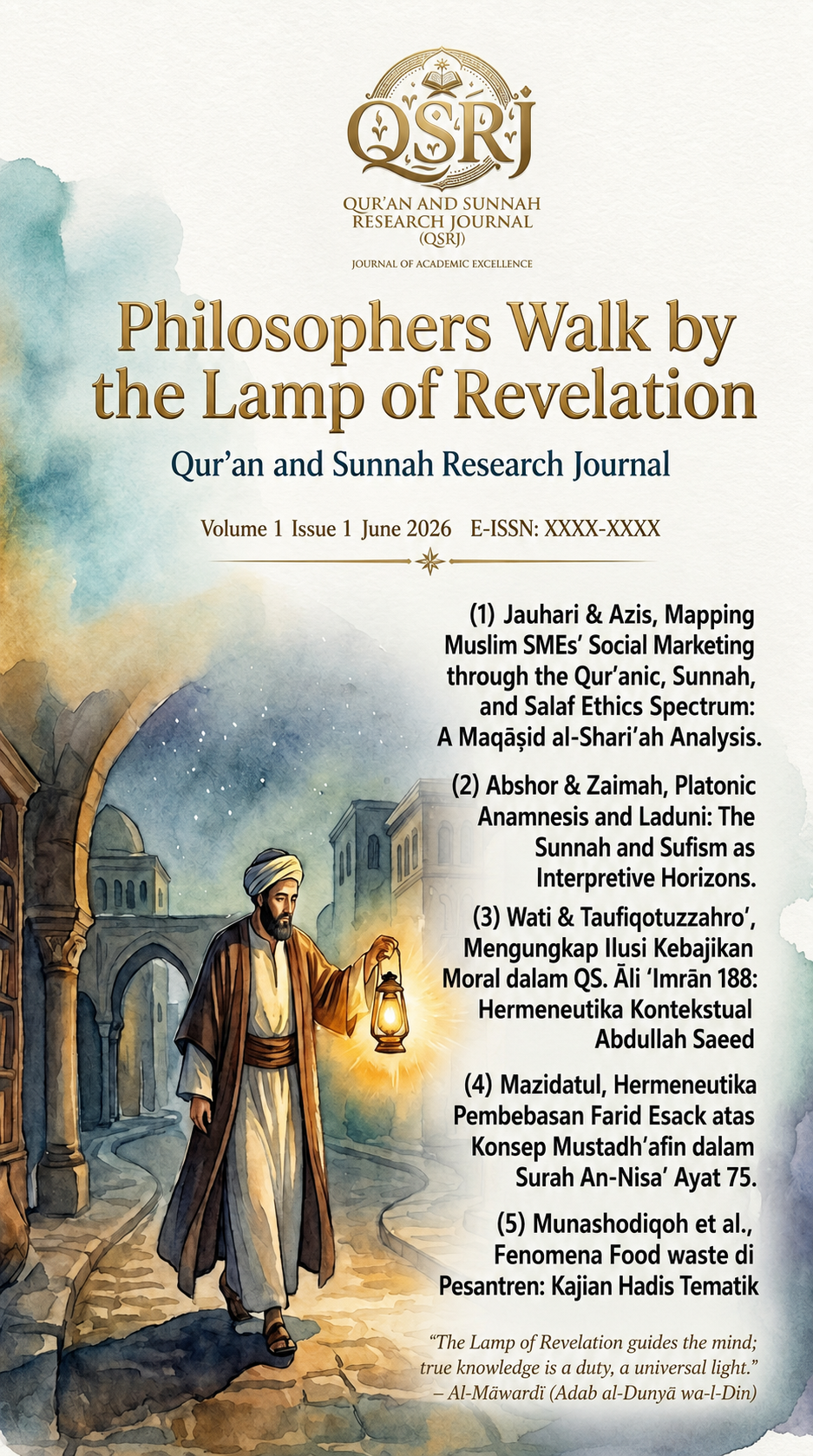
Mengungkap Ilusi Kebajikan Moral dalam QS. Āli ‘Imrān 188
Hermeneutika Kontekstual Abdullah Saeed
Keywords:
contextual hermeneutics, Abdullah Saeed , moral integrity , false praise , hypocrisy , ethical valuesAbstract
This study explores Surah Āli ‘Imrān [3]:188 using Abdullah Saeed’s contextual hermeneutical approach, highlighting its moral critique of false praise, hypocrisy, and pride in wrongdoing. The research is motivated by contemporary realities in which image construction, information manipulation, and symbolic morality increasingly shape public behaviour in digital society. Employing qualitative library research with a descriptive‑analytical method, it examines classical Qur’anic commentaries, asbāb al‑nuzūl traditions, and Saeed’s hermeneutics to uncover both the historical background and the universal ethical values contained in the verse. Findings show that the verse was revealed in response to certain groups among the Ahl al‑Kitāb and hypocrites who concealed truth, claimed recognition for deeds they did not perform, and felt pride in deception. Saeed’s contextual reading demonstrates that the verse transcends its original setting, offering a universal moral framework centred on integrity, honesty, responsibility, and ethical accountability. The study argues that this framework remains highly relevant today, especially in addressing phenomena such as hoaxes, self‑image manipulation, performative religiosity, and the pursuit of social legitimacy through false representation. Thus, Qur’an 3:188 functions not only as a theological warning but also as an ethical guide for maintaining moral integrity in modern society.
Downloads
Published
Issue
Section
License
Copyright (c) 2026 Ameliya Setia Wati, `Azzah Nurin Taufiqotuzzahro’ (Author)

This work is licensed under a Creative Commons Attribution-ShareAlike 4.0 International License.