Effectiveness of Reality Group Counseling in Reducing Academic Stress, Increasing Self-Esteem, and Improving Emotion Regulation of High School Students
Keywords:
Reality Group Counseling, Academic Stress, Self-Esteem, Emotion RegulationAbstract
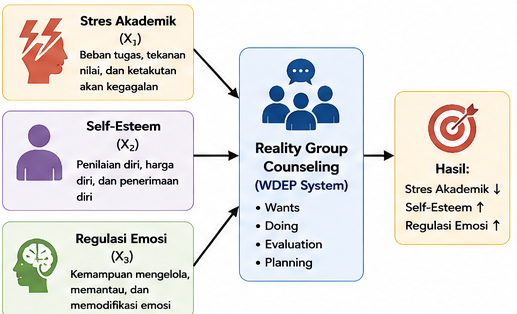
Academic stress, low self-esteem, and emotion dysregulation were common psychological problems experienced by high school students and negatively impacted well-being and academic achievement. This study aimed to examine the effectiveness of reality group counseling in reducing academic stress, increasing self-esteem, and improving emotion regulation among high school students. The method used was a true experiment with a pretest-posttest control group design. The sample consisted of 64 eleventh-grade students of SMAN 3 Klaten who had high academic stress, low self-esteem, and low emotion regulation, selected using purposive sampling. Students were then randomly assigned to an experimental group (n=32) receiving reality group counseling for 8 sessions (2 sessions/week) and a control group (n=32) with no intervention. The research instruments included the Academic Stress Scale (15 items, α=0.89), Rosenberg Self-Esteem Scale (10 items, α=0.87), and Emotion Regulation Scale (20 items, α=0.91). Data were analyzed using MANOVA with SPSS 26. The results showed that there was a significant multivariate difference between experimental and control groups on the three dependent variables (Wilks' Lambda = 0.32; F(3,60) = 42.56; p < 0.001; η² = 0.68). Follow-up tests indicated that reality group counseling effectively reduced academic stress (F = 38.45; p < 0.001; η² = 0.39), increased self-esteem (F = 45.21; p < 0.001; η² = 0.43), and improved emotion regulation (F = 52.34; p < 0.001; η² = 0.47) compared to the control group. These findings indicated that reality group counseling was an effective intervention for addressing psychological problems in high school students simultaneously.
Downloads
Published
Issue
Section
License
Copyright (c) 2026 Shafa Alistiana Irbathy (Author)

This work is licensed under a Creative Commons Attribution-ShareAlike 4.0 International License.