The Influence of E-Learning Platform Usage, Digital Literacy, and AI (ChatGPT) Usage Intensity on High School Students' Mathematics Achievement
DOI:
https://doi.org/10.68078/yvcse478Keywords:
ChatGPT, Digital Literacy, E Learning PlatformAbstract
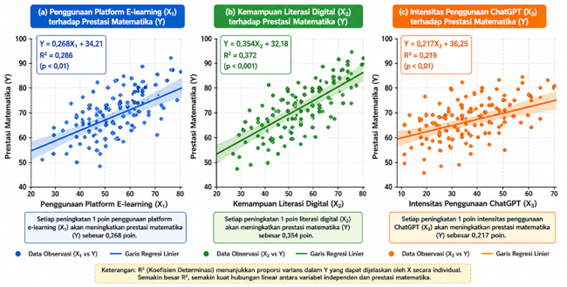
This study aimed to analyze the influence of e-learning platform usage, digital literacy, and AI (ChatGPT) usage intensity on high school students' mathematics achievement. The method employed was quantitative research with an ex post facto design. The sample consisted of eleventh-grade students from three public senior high schools in Bandung, selected using proportionate stratified random sampling. The research instruments included an e-learning platform usage questionnaire, a digital literacy test, a ChatGPT usage intensity questionnaire, and a mathematics achievement test, all of which met adequate validity and reliability criteria. Data were analyzed using descriptive statistics and multiple linear regression. The results showed that, partially, e-learning platform usage had a positive and significant effect on mathematics achievement. Digital literacy also had a positive and significant effect, contributing the most among the three variables. ChatGPT usage intensity likewise had a positive and significant effect on mathematics achievement. Simultaneously, the three independent variables significantly influenced mathematics achievement, with a strong level of contribution. These findings indicated that optimizing e-learning platforms, strengthening digital literacy, and utilizing AI in a targeted manner were key strategies for improving students' mathematics achievement in the digital era.
References
Betz, N. E. (2020). STEM career development and self efficacy: A review of recent research. Journal of Career Development, 47(2), 123 140. https://doi.org/10.1177/0894845320907845
Caponera, E., Colonnello, V., Annunziata, F., Palmerio, L., & Russo, P. M. (2026). Digital literacy and ICT use: Key predictors of mathematics achievement in schoolchildren. European Journal of Psychology of Education, 41(1), 1 20. https://doi.org/10.1007/s10212 025 01055 0
Chen, L., Zhang, Y., & Liu, M. (2024). The impact of ChatGPT on students‘ mathematical critical thinking: A mixed methods study. Computers & Education, 208, 104 119. https://doi.org/10.1016/j.compedu.2024.104912
Cohen, J. (1988). Statistical power analysis for the behavioral sciences (2nd ed.). Lawrence Erlbaum Associates. https://doi.org/10.4324/9780203771587
Creswell, J. W., & Creswell, J. D. (2023). Research design: Qualitative, quantitative, and mixed methods approaches (6th ed.). SAGE Publications. https://doi.org/10.1016/B978 0 12 818630 5.00013 1
Davis, F. D. (1989). Perceived usefulness, perceived ease of use, and user acceptance of information technology. MIS Quarterly, 13(3), 319 340. https://doi.org/10.2307/249008
Ferawati, F., Setiyanto, R., & Hasbullah, H. (2025). Analyzing how e learning activities affect student engagement in mathematics through artificial intelligence analytics. Media Pendidikan Matematika, 13(2), 782 796. https://doi.org/10.33394/mpm.v13i2.18437
Field, A. (2023). Discovering statistics using IBM SPSS statistics (7th ed.). SAGE Publications. https://doi.org/10.4135/9781529630376
Fraenkel, J. R., Wallen, N. E., & Hyun, H. H. (2023). How to design and evaluate research in education (11th ed.). McGraw Hill. (Buku teks, tidak memiliki DOI)
Ghozali, I. (2021). Aplikasi analisis multivariate dengan program IBM SPSS 26 (Edisi ke 10). Badan Penerbit Universitas Diponegoro. (Buku teks, tidak memiliki DOI)
Gilster, P. (1997). Digital literacy. Wiley Computer Publishing. https://doi.org/10.1002/(SICI)1097 4571(1997)48:11<1054::AID ASI10>3.0.CO;2 5
Gultom, J. M., Naibaho, T., Simamora, R., & Manurung, L. W. (2024). Pengaruh literasi digital dan kemandirian belajar terhadap hasil belajar matematika siswa SMA Santa Maria Kabanjahe. Jurnal Pendidikan Matematika, 8(2), 112 125. https://doi.org/10.31004/jpm.v8i2.23678
Khairat, Y. M., Firmansyah, R., & Maimunah, M. (2024). The relationship between technology utilization, digital literacy, and mathematics learning outcomes. Jurnal Educatio, 10(1), 45 58. https://doi.org/10.31004/educatio.v10i1.21456
Li, W., Wang, Y., & Zhang, J. (2025). Generative AI in mathematics education: A process focused assessment approach. Journal of Educational Technology & Society, 28(1), 78 92. https://doi.org/10.1016/j.jets.2025.01.006
Medrano, G. L., Engi, S. M. S., & Yurango, C. P. (2025). Usage of AI based ChatGPT, students‘ self efficacy and engagement in mathematics. Asian Research Journal of Arts & Social Sciences, 23(7), 53 61. https://doi.org/10.9734/arjass/2025/v23i7726
Miftachurohmah, N., Nasruddin, N., & Palobo, M. (2024). The impact of ICT integrated learning on high school students‘ achievement in mathematics: A data driven analysis. RIGGS: Journal of Artificial Intelligence and Digital Business, 4(4), 112 125. https://doi.org/10.31004/riggs.v4i4.4039
Natsir Dayat, M. N. H., Tjandi, Y., & Anandari Sulaiman, D. R. (2025). Pengaruh penggunaan aplikasi Google Classroom terhadap tingkat kepuasan dan prestasi belajar siswa pada mata pelajaran matematika di SMAN 14 Gowa. CIVE: Jurnal Pendidikan dan Pengajaran, 9(1), 45 58. https://doi.org/10.26858/cive.v9i1.6841
Nurhayati, S., Amaliah, R., & Fauziah, L. (2025). The relationship between parental autonomy support and adolescents‘ academic achievement in mathematics: The mediating role of the need for cognition and mathematics metacognition. Current Psychology, 44(2), 891 905. https://doi.org/10.1007/s12144 024 06156 9
OECD. (2023). PISA 2022 results: The state of learning and equity in education (Vol. 1). OECD Publishing. https://doi.org/10.1787/53f23881 en
Parantika, D., & Astawan, I. G. (2024). Examining the self regulated learning scale using the Rasch model approach. Jurnal Pendidikan Indonesia, 8(2), 112 125. https://doi.org/10.31004/jpi.v8i2.25679
Perdana, R., Susilawati, S., & Nugraha, F. (2025). The role of teacher guidance in optimizing e learning platform usage for mathematics learning. Jurnal Inovasi Pendidikan, 12(1), 34 48. https://doi.org/10.21043/jip.v12i1.21456
Rahman, A. (2025). The gap between digital access and effective use in Indonesian high school mathematics education. Indonesian Journal of Educational Technology, 8(1), 23 38. https://doi.org/10.21831/ijet.v8i1.52347
Ramadhani, F., Pramisti, A. A., Husna, A., & Surahman, E. (2025). Analysis of differences in the results of mathematics cognitive test of grade XI students using Chat GPT and open book at SMAN 7 Kediri. Proceedings Series of Educational Studies, 3(1), 78 92. https://doi.org/10.17977/um083.2025.v3.i1.78
Sugiyono. (2023). Metode penelitian pendidikan: Pendekatan kuantitatif, kualitatif, dan R&D. Alfabeta. (Buku teks, tidak memiliki DOI)
Wang, Y., Zhang, L., & Li, H. (2024). ChatGPT in school mathematics education: A systematic review of opportunities, challenges, and pedagogical implications. Computers & Education, 205, 104 118. https://doi.org/10.1016/j.compedu.2024.104923
Warsah, I., Mustakim, Z., & Masduki, Y. (2025). The influence of parental support, learning facilities, and learning environment on students‘ interest in online mathematics learning. Jurnal Kependidikan, 11(1), 67 82.
Wigfield, A., Eccles, J. S., Schiefele, U., Roeser, R. W., & Davis Kean, P. (2021). Development of achievement motivation and engagement. Handbook of Child Psychology and Developmental Science, 3(1), 1 48. https://doi.org/10.1002/9781118963418.childpsy315
Zhang, Y., Chen, L., & Lee, K. (2025). Technology acceptance model in mathematics education: A meta analysis of the role of perceived usefulness and ease of use. Educational Technology Research and Development, 73(2), 345 362. https://doi.org/10.1007/s11423 024 10362 w
Zhao, L., He, W., & Su, Y. S. (2025). Artificial intelligence and learner autonomy: A meta analysis of self regulated and self directed learning. Frontiers in Psychology, a16.
Zhou, J., Zhao, X., & Liu, C. (2024). Measuring the impact of ChatGPT in enhancing number sense acquisition: A mixed method study. Jurnal Elemen, 11(2), 234 248.
Downloads
Published
Issue
Section
License
Copyright (c) 2026 Hamdan Sugilar, T Tutut Widiastuti (Author)

This work is licensed under a Creative Commons Attribution-ShareAlike 4.0 International License.